Basement Flooding Cleanup in Overland Park, KS
A flooded finished basement is carpet, pad, drywall and framing all soaking at once. The restoration team extracts it, decides what can be dried in place, and dries the rest to a verified reading.
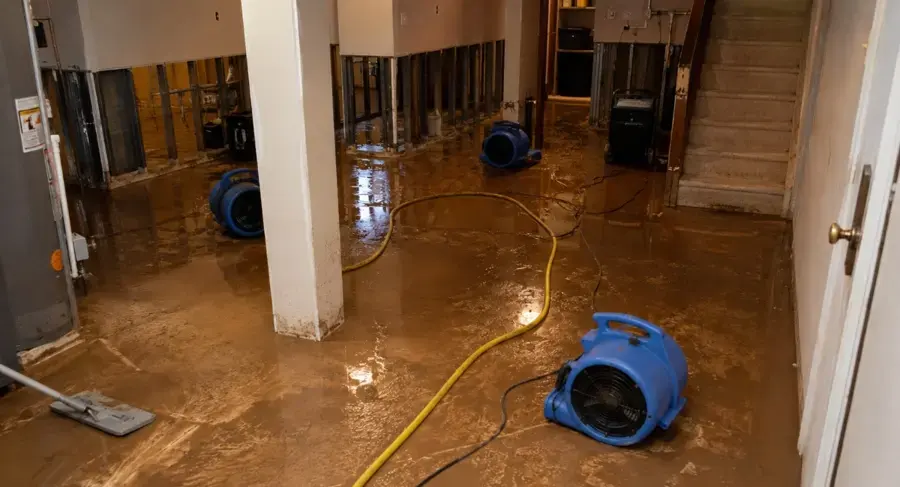
What to do the moment you find a flooded basement
- Stay off wet carpet near outletsWater and electricity meet at baseboard outlets.
- Find the sourceCheck the sump pit, floor drain and water heater.
- Photograph firstTake pictures before moving furniture or boxes.
- Call for cleanupThe restoration team extracts before the water wicks higher.
How a flooded basement is handled in Overland Park, KS
- 01First visit
Moisture mapping
The tech who does the walkthrough maps wet materials with pinless meters and thermal imaging before any equipment goes down.
- 02Day 0
Extraction
The extraction crew pulls standing water with truck-mounted extraction and sets the category and class of the loss.
- 03Days 1 to 3
Air movers and LGR
The drying team sizes air movers and LGR dehumidifiers to each room's evaporation load and records readings daily.
- 04Days 3 to 5, typical
Dry verification
Equipment comes out when the readings reach the drying goal. Hardwood, plaster and slab take longer.
The drying goal: wet materials read within 2 to 4 points of a dry reference material in the same building. Equipment leaves on readings, not on a schedule.
What does a flooded basement cost in Overland Park, KS?
In Overland Park, KS, basement flooding cleanup typically runs $1,500 to $10,000 or more, depending on the water category, how much of the lower level is finished, and what has to come out.
- Extraction
- Air movers and dehumidifier
- Daily readings
- Pad and baseboard removed
- Wall-cavity drying
- Moisture mapping
- Sewage or floodwater
- Flood cuts and antimicrobial
- Full structural drying
What moves the number: the water category, square footage, how much drywall and flooring is finished, and how fast drying started. For a closer planning range, try the water damage cost calculator. These are typical ranges, not quotes.
Johnson County builds with basements. From 1970s split-levels near Oak Park to newer two-story homes in Blue Valley, most Overland Park houses have a lower level, and many are finished with carpet, drywall, a bathroom and a bedroom. When water gets in, it gets into all of that at once.
Where the water comes from
- A failed or overwhelmed sump pump during a spring cloudburst
- A sewer backup through the floor drain
- Seepage through foundation cracks as the clay soil swells
- A water heater or washer in the utility room
- Surface water running in through a window well or walkout door
The source matters because it sets the water category. Clean water from a supply line is Category 1. Sump and seepage water is usually treated as Category 2. Sewage and outside floodwater are Category 3, and porous materials those touch come out.
Dry in place or cut
The tech who does the walkthrough maps the moisture before anything is torn out. On a clean-water loss caught early, drywall can often be dried in place by drilling small holes at the base and forcing air into the cavity. When water wicked high, sat for days, or was contaminated, the mitigation team makes a flood cut, usually two or four feet up, and removes the wet section and the insulation behind it.
Photograph everything before it is moved or removed. Timestamped photos before demolition are part of a complete claim file.
Drying a basement in Kansas humidity
Basements are cool and humid, and summer air in Kansas City is heavy with moisture. LGR dehumidifiers matter more here than air movers alone, because the air has to be dried before it can pull water out of the slab and framing. For flood risk around your street, the City of Overland Park flooding and stormwater page and FEMA flood maps are good places to look.
Covering Overland Park and nearby Johnson County
The restoration team covers every Overland Park ZIP, from Downtown Overland Park and Nall Hills to Blue Valley, Stanley and Morse, plus Leawood, Olathe, Lenexa, Shawnee, Merriam, Mission and Prairie Village.
See every neighborhood and ZIP coveredBasement Flooding Cleanup questions in Overland Park, KS
Can a finished basement be saved after flooding?
Often, yes. Clean water caught early can usually be dried in place. Contaminated water or water that sat for days means more removal.
How high do flood cuts go?
Usually two or four feet, set by the moisture readings, not by guesswork. Cutting at a standard height also makes the rebuild simpler.
Why does my basement flood when it rains hard?
Heavy rain can overwhelm the sump, back up the sanitary sewer through the floor drain, or push water through foundation cracks. Each needs a different fix.
How long does basement drying take?
A contained loss usually dries in three to five days. Concrete block walls and hardwood take longer.
Should I run my own fans?
Fans help air move, but without dehumidification a basement just gets more humid. Professional drying pairs air movers with LGR dehumidifiers.
Is basement flooding covered?
It depends on the source. Plumbing leaks, sewer backups and surface water are often treated differently. Coverage depends on your policy, so it is worth checking with your own insurer.
Flooded basement in Overland Park? Call now.
The restoration team extracts, maps the moisture and dries the lower level to the IICRC S500 standard.