Structural Drying in Overland Park, KS
Surfaces dry in a day; framing, subfloor and slab do not. The drying team runs equipment to the room's evaporation load and pulls it only when the readings say dry.
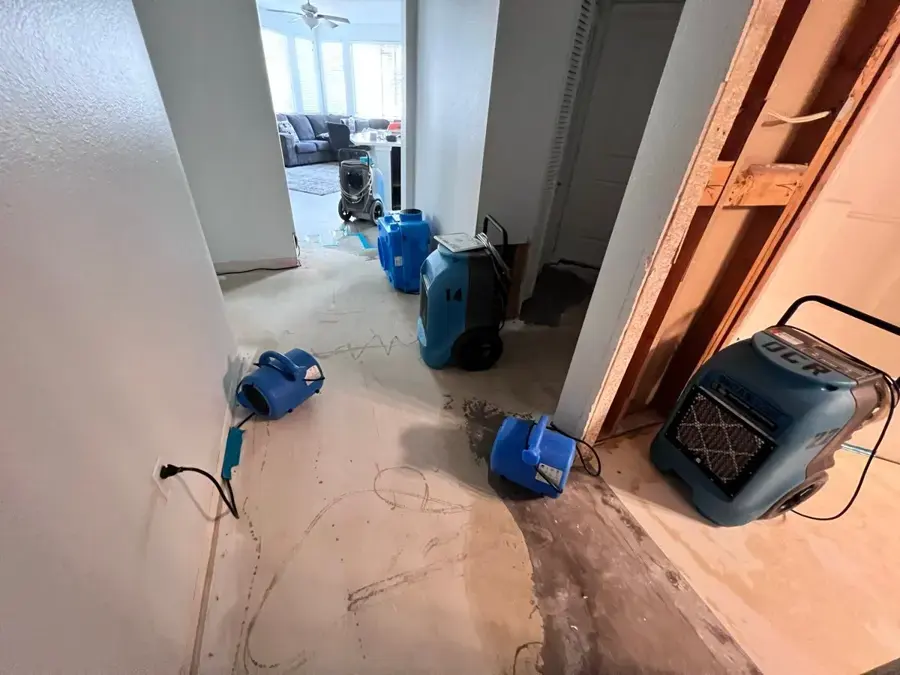
What to do the moment you find structural drying
- Leave the equipment onTurning it off slows drying and resets progress.
- Keep doors and windows as setThe drying team sets up a closed drying chamber.
- Do not refinish yetPaint and flooring go in only after readings pass.
- Call with questionsAsk for the daily readings any time.
How structural drying is handled in Overland Park, KS
- 01First visit
Moisture mapping
The tech who does the walkthrough maps wet materials with pinless meters and thermal imaging before any equipment goes down.
- 02Day 0
Extraction
The extraction crew pulls standing water with truck-mounted extraction and sets the category and class of the loss.
- 03Days 1 to 3
Air movers and LGR
The drying team sizes air movers and LGR dehumidifiers to each room's evaporation load and records readings daily.
- 04Days 3 to 5, typical
Dry verification
Equipment comes out when the readings reach the drying goal. Hardwood, plaster and slab take longer.
The drying goal: wet materials read within 2 to 4 points of a dry reference material in the same building. Equipment leaves on readings, not on a schedule.
What does structural drying cost in Overland Park, KS?
In Overland Park, KS, structural drying typically runs $1,000 to $7,000, driven mostly by the number of rooms, the material class and how many days equipment has to run.
- Air movers and LGR
- Three to four days
- Daily readings
- Cavity drying
- Several dehumidifiers
- Psychrometric logs
- Hardwood or slab
- Desiccant drying
- Longer run time
What moves the number: the square footage, the material class, the number of days equipment runs, and how fast drying started. For a closer planning range, try the water damage cost calculator. These are typical ranges, not quotes.
Structural drying is the part of the job that decides whether water damage comes back as warped floors, swollen trim or a musty basement. IICRC S500 is the industry drying standard, and it treats drying as a measured process: map the moisture, set the right equipment, record readings, and stop only when the materials are dry.
How the drying is set up
- Moisture mapping with pinless meters and thermal imaging before equipment goes down
- Class 1 to 4 sets how much equipment a room needs, based on how much wet surface and how porous it is
- Air movers set to the room's evaporation load, aimed along walls and under cabinets
- LGR dehumidifiers that pull water out of cool basement air
- Desiccant dehumidifiers for Class 4 materials like hardwood, plaster and concrete
- Wall-cavity and floor drying systems that push air where it cannot reach on its own
The drying goal
The drying team takes a reading from a dry reference material in an unaffected part of the same house, then compares wet materials to it every day. Equipment comes out when the wet materials read within 2 to 4 points of that reference. A contained Class 1 loss usually dries in three to five days. Hardwood, plaster and a concrete basement slab take longer.
Equipment stays until the readings say dry, not until the room looks dry. That rule is what keeps hidden moisture from turning into a second problem.
Records for the claim file
Daily moisture readings and psychrometric logs, temperature and humidity inside and out, document that the job met the standard. Many adjusters expect to see them. For flood preparedness, see Ready.gov floods and the NWS Kansas City office. Drying usually follows water extraction.
Covering Overland Park and nearby Johnson County
The restoration team covers every Overland Park ZIP, from Downtown Overland Park and Nall Hills to Blue Valley, Stanley and Morse, plus Leawood, Olathe, Lenexa, Shawnee, Merriam, Mission and Prairie Village.
See every neighborhood and ZIP coveredStructural Drying questions in Overland Park, KS
What is IICRC S500?
It is the industry drying standard for water damage restoration. It sets how water losses are inspected, dried and verified.
How is dry measured?
Wet materials are compared to a dry reference in the same house. Drying is done when they are within 2 to 4 points.
Why are there so many machines?
Class 1 to 4 sets how much airflow and dehumidification a room needs. More wet surface means more equipment.
Can I turn the equipment off at night?
It is best not to. Drying depends on steady airflow and dehumidification.
What is a desiccant dehumidifier?
A dehumidifier that uses a drying material instead of cold coils. It works well on dense Class 4 materials.
How long will the equipment run?
Usually three to five days for a contained loss; longer for hardwood, plaster and slabs.
Need structural drying in Overland Park? Call now.
The drying team maps, dries and logs every reading until the materials reach the IICRC S500 goal.